Opening: Friday, 18 July 2026, 7–9pm
For many people, growing up means moving forward, but some of the most important discoveries happen only after a long detour.
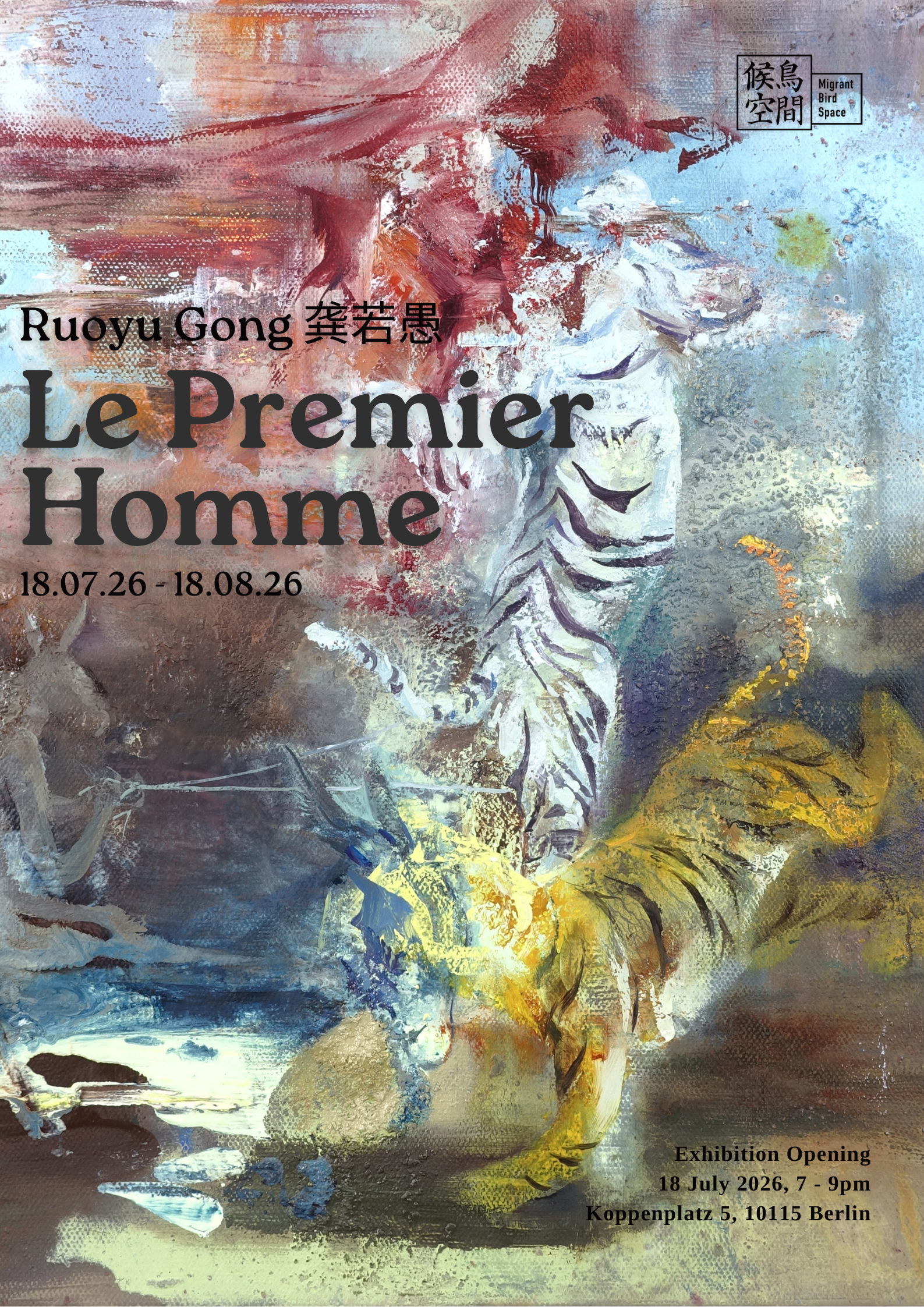
In recent years, Ruoyu Gong's work has revolved around an ongoing inner negotiation. Human figures, animals, and entangled relationships recur throughout his paintings, appearing at once as reflections of lived experience and as different actors within the same psychological landscape. Desire and restraint, freedom and discipline, intuition and control continually meet, collide, and hold one another in tension.
The exhibition title, Le Premier Homme, is borrowed from Albert Camus's unfinished final novel. The reference is not intended to frame the work through literature, but rather to evoke a similar condition: the moment when, after a long journey of departures and returns, one is compelled to face oneself again and reconsider one's place in the world.
Born in Beijing and educated in the United States, Gong's practice is shaped by both rigorous academic training and a deep trust in the unpredictable nature of painting itself. The donkeys, tigers, peacocks, and struggling figures that populate his canvases do not form a coherent narrative. Instead, they emerge as fragments of an expanding inner world, reflecting an artist's ongoing engagement with questions of identity, desire, order, and freedom.
Le Premier Homme is an exhibition about a beginning, or at least the process of looking for one.
About the Artist
Ruoyu Gong (b. 1999, Beijing) lives and works in New York. He received his MFA in Painting from the New York Academy of Art in 2025, following studies at the Rhode Island School of Design and the Central Academy of Fine Arts.
Working primarily through painting while also engaging with printmaking, collage, bas-relief, and mixed media, Gong's practice explores the space between figuration and abstraction, intention and chance. Human figures, animals, and spatial fragments emerge and dissolve throughout his works, gradually giving way to gesture, color, and movement.
Raised in China and educated in the United States, Gong draws from both Eastern and Western artistic traditions. The physicality of classical painting, the psychological complexity of contemporary figurative art, and the poetic ambiguity of Chinese aesthetics converge within a practice that continually tests the possibilities of painting today.
His work has been exhibited internationally in New York, Milan, London, Shanghai, and Guangzhou, and has received several awards, including First Prize at the YICCA International Contemporary Art Award.